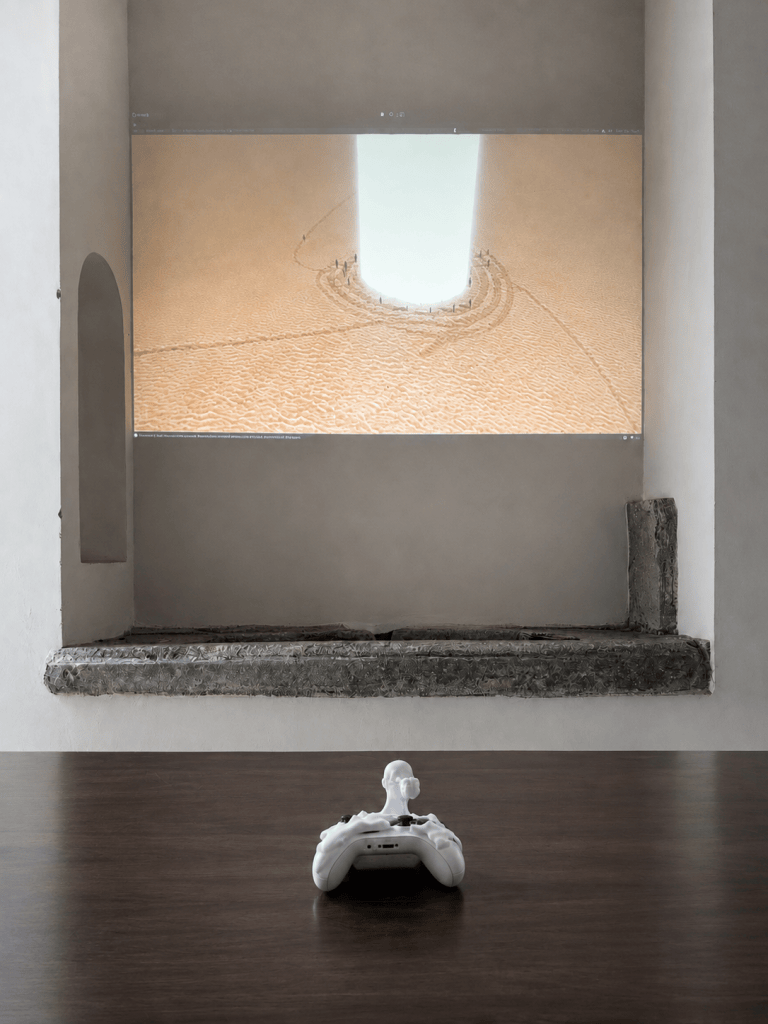
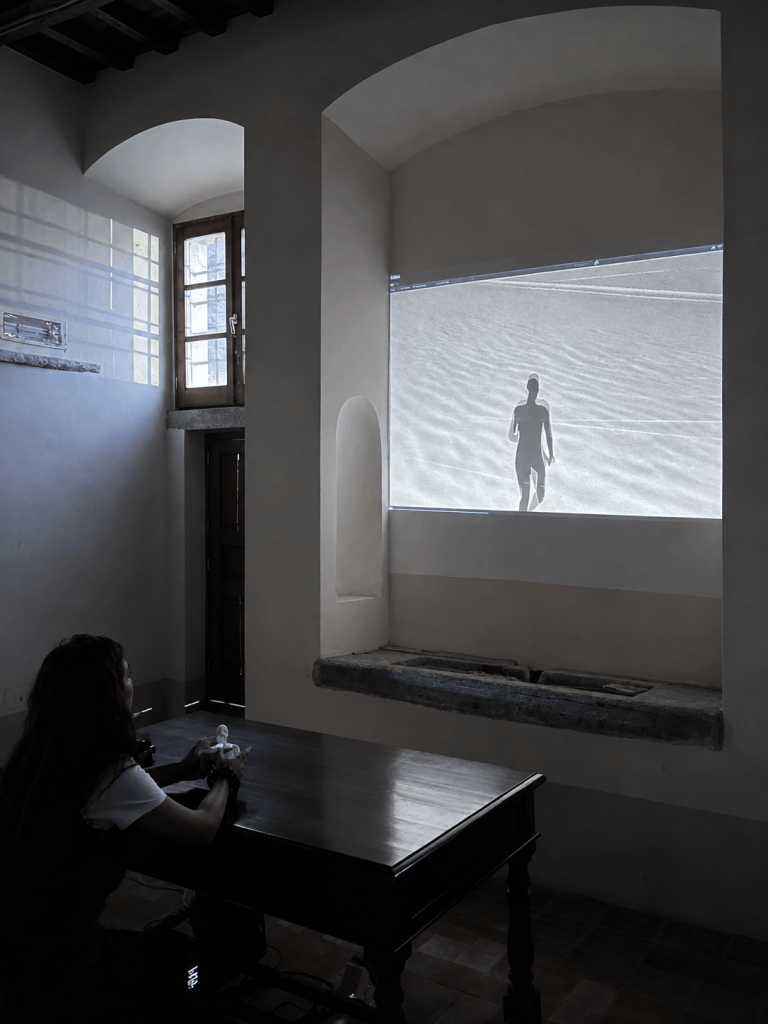
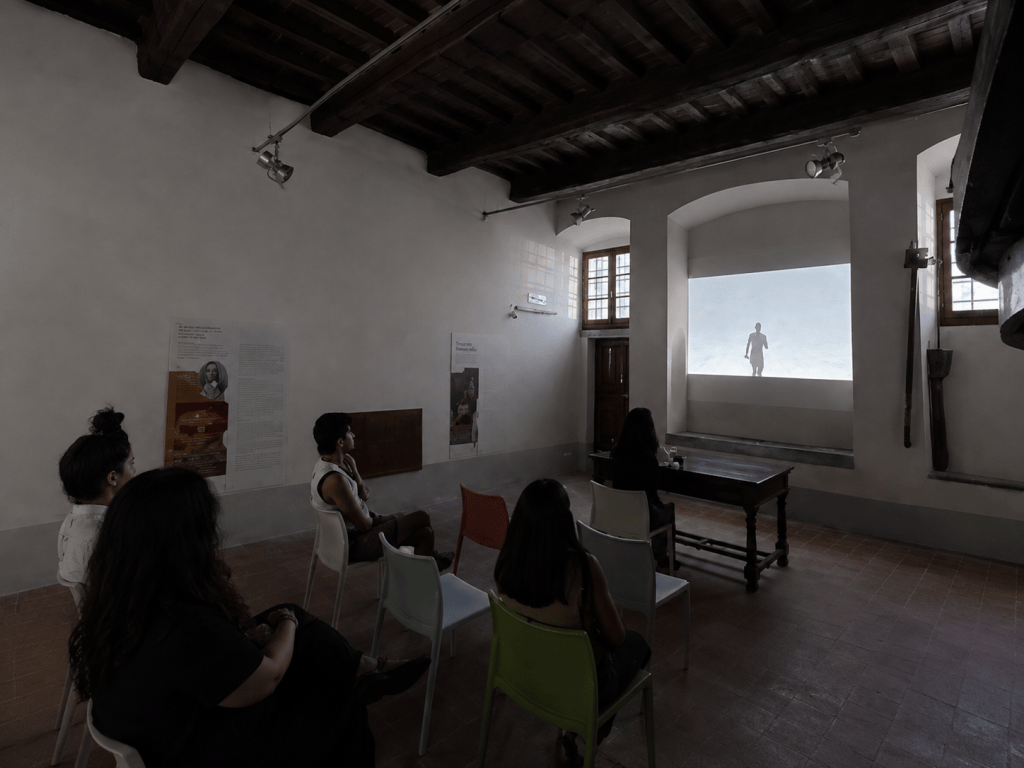
The project is adapted to the specific spatial conditions of each exhibition. Real objects from the exhibition site are 3D-scanned and reintroduced into the virtual space constructed by the work, allowing objects from the physical environment to reappear before the viewer in digital form. Through this overlap between the real and the virtual, the work seeks to reduce the distance that normally separates the two, while strengthening the participant’s sense of immersion and presence within the virtual environment.
Fana, 2026, PhygitArt VII, Perugia
The work takes the form of an open world, allowing players to move freely through and explore the virtual space. Here, free exploration is not only a mode of interaction, but also an integral part of the work’s narrative mechanism. The space initially maintains a certain predetermined order. However, as players gradually approach its central area, their presence and actions begin to interfere with and disrupt that order.
Fana, 2026, PhygitArt VII, Perugia
The player’s most natural impulses—to observe, explore, become curious, and move closer—paradoxically become the very causes of the disruption of the original state. The more the player attempts to approach, understand, and intervene, the more visible the impact of their actions becomes, while at the same time causing deeper suffering to the beings that inhabit the space. In this way, the work transforms “exploration,” an action traditionally associated with positive progress in games, into something fundamentally contradictory: in attempting to understand the work, the player is compelled to move closer, yet it is precisely through this process of approaching that they become a source of suffering. When the player eventually realizes that their continued presence can only perpetuate this suffering, the only action that can truly bring the process to an end is to voluntarily leave the game.